Written by Angelina Gabrielle Rebolledo
Photos courtesy of Keziah Jane Paganas
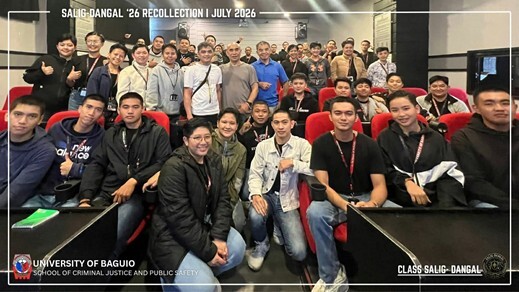
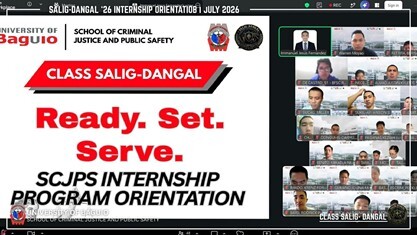
BAGUIO CITY – On July 26, 2026, the School of Criminal Justice and Public Safety (SCJPS) successfully conducted the Internship Program Orientation via Zoom, formally preparing the Class Salig-Dangal for their upcoming internship deployment. The virtual gathering brought together Criminology and Forensic Science interns, faculty members, and program coordinators in a shared commitment to producing well-rounded, ethical, and highly capable future professionals in the field of Criminal Justice and Public Safety.
The orientation aimed to equip interns with the knowledge, policies, guidelines, and professional standards necessary to ensure a successful and ethical internship experience. More than a procedural briefing, the program served as a values-driven send-off, reminding students that their internship journey is both an academic requirement and a real-world test of character.
The program opened with welcome remarks from Mr. Justin Joseph T. Almarvez, UB SCJPS, Assistant Internship Coordinator, who encouraged the students to uphold integrity, discipline, and professionalism as the interns step into their respective internship placements. He reminded the class to carry these values with them, embodying the very identity class name represents a strong and steadfast foundation of dignity.
The keynote presentation was delivered by Mr. Immanuel Jesus A. Fernandez, UB-SCJPS Internship Coordinator, who provided a comprehensive orientation anchored in the SCJPS Internship Policy. He explained the objectives, requirements, and structure of the internship program and guided the interns through its three major phases: pre-immersion, immersion, and post-immersion. For the pre-immersion phase, he discussed eligibility and documentary requirements, portfolio and profile submission, enrollment procedures, parental consent, mandatory student and parent orientation, medical and drug-testing clearances, internship agreements, and required pre-deployment training. He also clarified the policy requiring students to complete all academic units before beginning their internship and the conditions they must satisfy before deployment to a Host Training Establishment (HTE).
For the immersion phase, Mr. Fernandez emphasized punctuality, proper uniform and grooming, professional and ethical conduct, compliance with University and HTE policies, completion of the prescribed training hours, and mandatory attendance at assigned duties, reporting sessions, seminars, workshops, and other approved activities. He explained the proper accomplishment and weekly certification of the Daily Time Record, the maintenance of a daily internship journal, the purpose of monitoring visits, and the interns’ accountability for their conduct and assigned responsibilities. He also discussed the consequences of absences, falsification of records, and other policy violations, including the corresponding make-up duties and disciplinary measures.
Mr. Fernandez likewise outlined the interns’ post-immersion responsibilities, including the completion of required training hours, submission of documentary and narrative requirements, academic and nonacademic assessments, HTE performance evaluations, and qualification for certificates of completion or recognition. By presenting the provisions of the Internship Policy in a clear and systematic manner, he provided Class Salig-Dangal 2026 with a practical roadmap for the entire internship journey. His presentation ensured that the interns understood the standards, responsibilities, procedures, and consequences governing the program, enabling them to enter their respective placements fully informed, disciplined, accountable, confident, and prepared to represent SCJPS and the University of Baguio with competence and distinction.
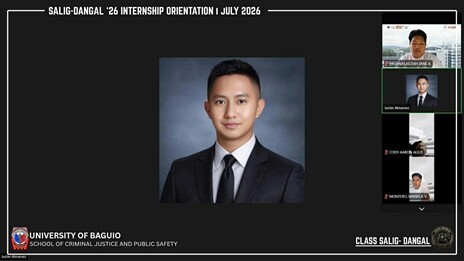
The orientation concluded with closing remarks from Mr. Justin Kyle C. Aluad, Class Salig-Dangal President, who expressed appreciation for the support extended by the SCJPS administration, faculty members, program chairs, and the entire Salig-Dangal Class. His message served as a fitting close to the program, reinforcing a sense of unity and shared purpose as the students prepared to embark on this significant milestone in their academic journey.
In line with this mission, the program targets Sustainable Development Goals (SDGs), reflecting SCJP’s broader commitment to producing graduates who are academically prepared, professionally competent, and socially responsible. Under SDG 4.4, which calls for substantially increasing the number of youth and adults with relevant skills for employment and decent jobs, the orientation strengthened students’ academic, professional, and leadership competencies, ensuring a solid foundation for their internship experience. Under SDG 8.6, which addresses reducing the proportion of youth not in employment, education, or training, the program’s clear guidelines on professional conduct, attendance, and workplace expectations prepared interns for meaningful, productive engagement in their future careers. Under SDG 16.6, which calls for developing effective, accountable, and transparent institutions, the interns were reminded of their role as future practitioners in criminology and forensic science in upholding justice, accountability, and integrity within the institutions they will serve. Under SDG 17.17, which promotes effective partnerships across sectors, the collaborative effort among the SCJPS administration, faculty, program chairs, and students in preparing for this milestone reflected the value of shared responsibility in achieving these goals. By anchoring the orientation to these global targets, SCJPS reaffirmed its dedication to shaping graduates who are not only technically skilled but also socially responsible.